Plan patches and straight pieces
How many rectangles fit on this piece of fabric?
Compare a uniform grid with the same grid turned 90 degrees. Useful for rectangular patches or simple cut pieces. Enter full cutting dimensions, including any seam allowances you need.
This is a grid comparison, not an optimal nesting algorithm or a yardage estimate for shaped garment pieces. Grain, nap, pattern matching, fabric defects and shrinkage need separate decisions.
Grid comparison
What is counted
For each orientation, subtract twice the edge margin from each fabric dimension. Then calculate:
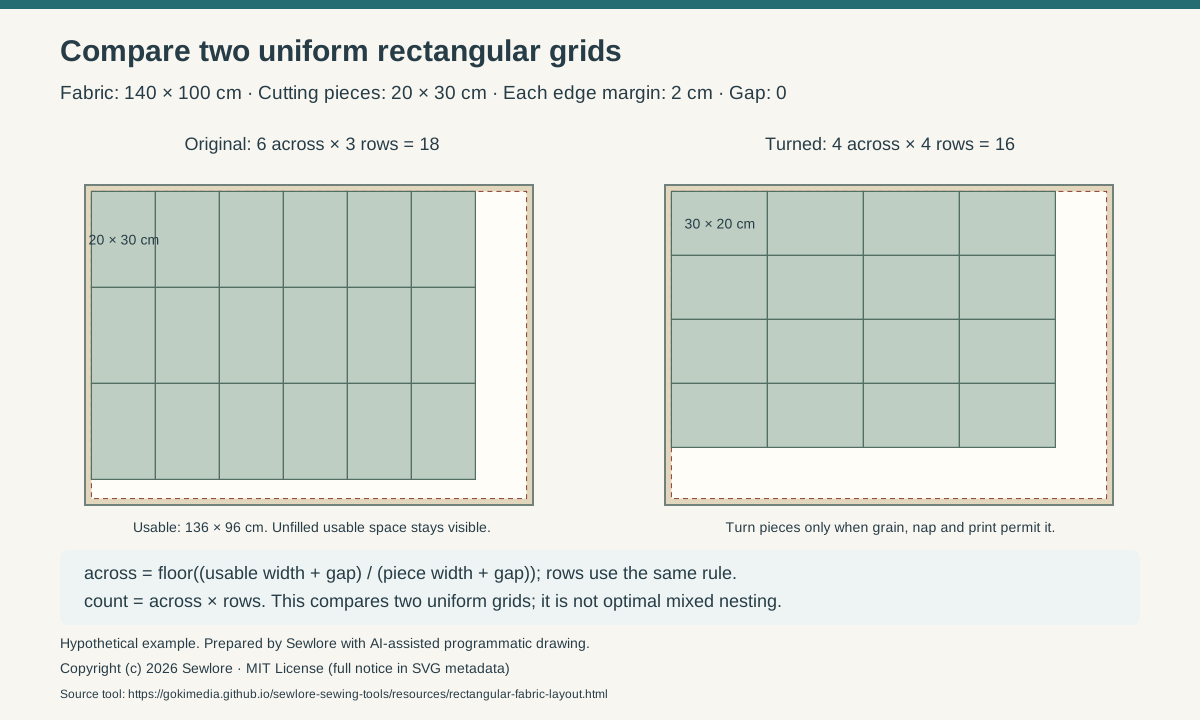
across = floor((usable width + gap) ÷ (piece width + gap))rows = floor((usable length + gap) ÷ (piece length + gap))count = across × rows
The extra gap in each numerator prevents charging a gap beyond the last piece. With 140 × 100 cm fabric, a 2 cm margin on every edge, and 20 × 30 cm pieces without gaps, the usable area is 136 × 96 cm. The original grid fits 6 × 3 = 18 pieces. If rotation is permitted, the turned grid fits 4 × 4 = 16 pieces.
Before cutting
Measure usable fabric after any planned prewashing. Confirm the cutting rectangle, grain direction, allowance and motif requirements. A mixed-orientation layout may fit more pieces than these two grids; lay out paper templates before cutting valuable fabric.
Record care conditions and original dimensions with Sewlore's fabric measurement methods guide.
Download the worked diagram
Download the original SVG example to adapt for a lesson. The diagram follows the repository MIT licence; retain its copyright and licence notice when reusing it. Its measurements are hypothetical.
Embed this comparison in a sewing lesson
This iframe can be used on a page that supports HTML. Attribution is optional, and the publisher may choose the link text and rel attribute. It contains no tracking code.